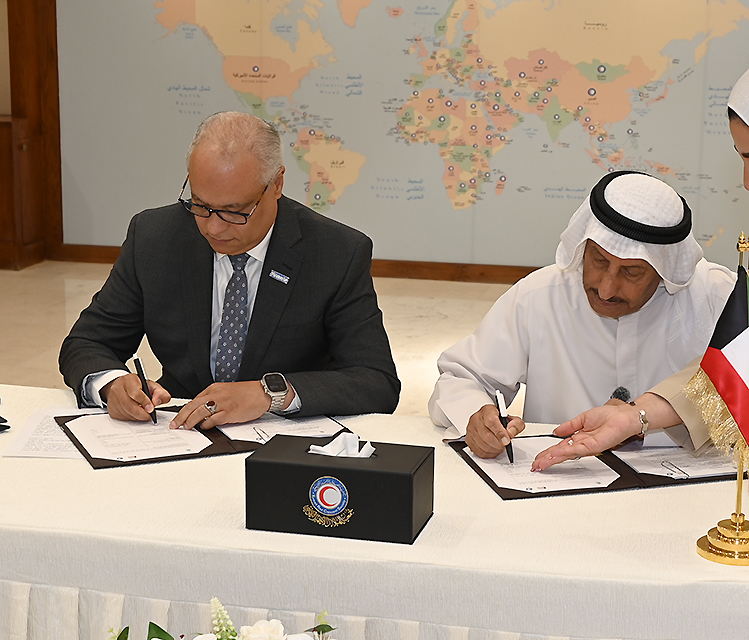
The Kuwait Red Crescent Society signed a grant agreement with the United Nations High Commissioner for Refugees (UNHCR) to support Rohingya refugees in Bangladesh, with the aim of carrying out shelter rehabilitation works and providing sustainable housing solutions for approximately 2,000 refugee families, thereby contributing to improving their living conditions and enhancing their humanitarian stability.
The Chairman of the Board of Directors of the Society, Khaled Al-Mughamis, stated in a statement to the Kuwait News Agency (KUNA) that this agreement represents an extension of the humanitarian role that Kuwait plays in supporting the most vulnerable groups affected by humanitarian crises around the world, stemming from its well-established humanitarian approach and its steadfast vision of providing relief to those in distress.
Al-Mughamis clarified that the Society's contribution, amounting to more than USD 300,000, represents the third contribution funded from Zakat funds to support Rohingya refugees in Bangladesh, as part of the Society's ongoing commitment to assisting the most needy groups and contributing to the improvement of their living conditions and the alleviation of their suffering.
He added that the agreement embodies the shared commitment with UNHCR to assist refugees around the world, reinforcing common humanitarian values and goals.
For his part, the Advisor to the High Commissioner and Representative of UNHCR to the Gulf Cooperation Council states, Khaled Khalifa, affirmed that the agreement represents a continuation of the ongoing humanitarian partnership between the two sides and a reaffirmation of their shared commitment to supporting the most vulnerable groups, particularly Rohingya refugees in Bangladesh.
Khalifa stated that this partnership has been built on solid foundations of cooperation and mutual trust, noting that the two parties had previously signed two similar agreements that contributed to the implementation of projects for the rehabilitation and improvement of shelters, providing refugee families with safer and more dignified housing in the face of harsh climatic conditions.